
The single highest-leverage change most Australian B2B teams could make in 2026 isn't a new campaign, a different agency, or a smarter ICP. It's responding to inbound leads faster.
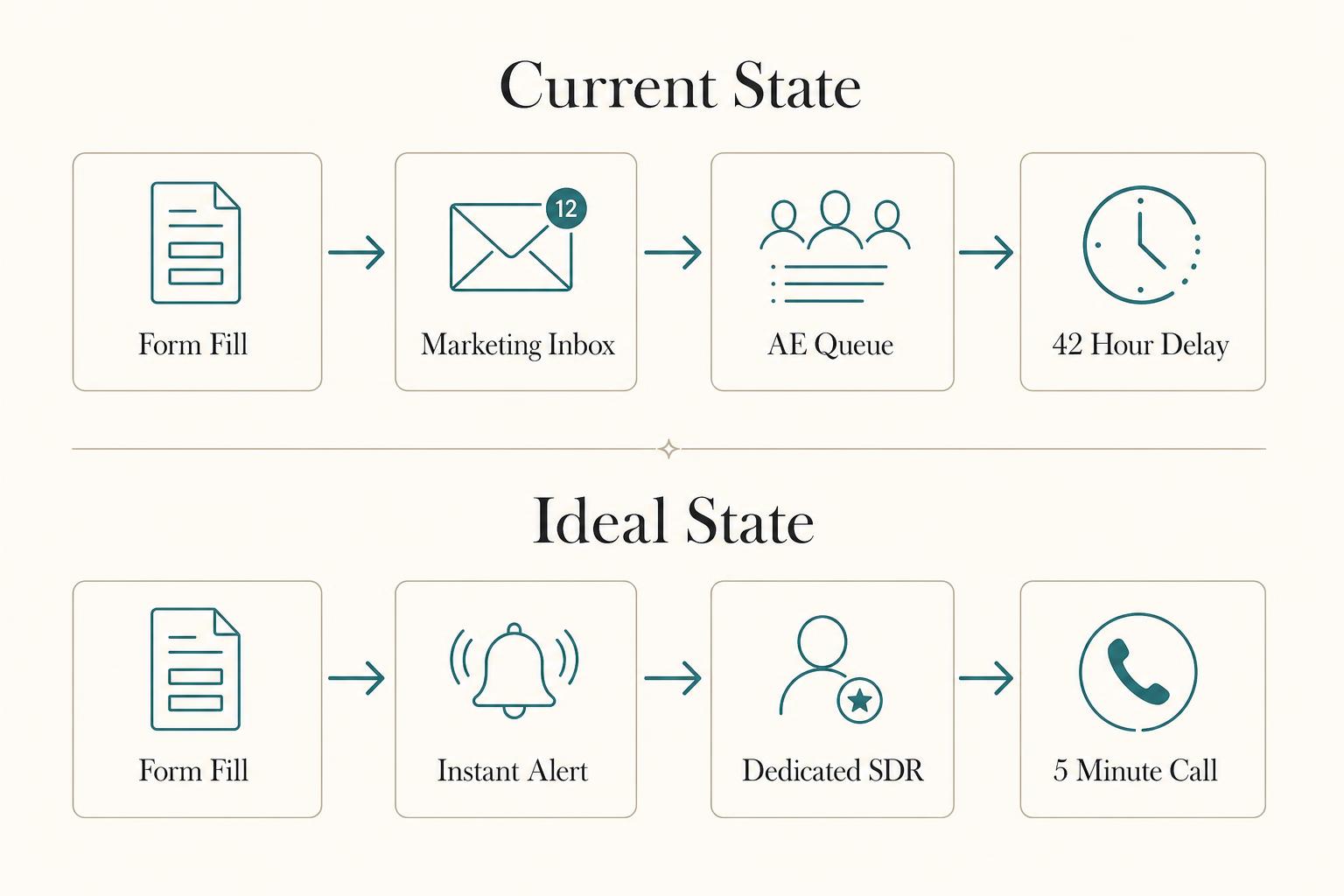
The data is unambiguous and has been for over a decade. Companies that respond to inbound leads within 5 minutes are 21 times more likely to qualify the lead than companies that respond at 30 minutes. The first business to respond wins roughly 50% of competitive deals. And the average B2B response time across thousands of companies sits at 42 hours.
That gap, between what the data says works and what most teams actually do, is the largest unexploited margin in Australian B2B sales right now.
This guide breaks down the speed-to-lead data, why most Australian teams fail at it, and the operational playbook for getting to a real 5-minute response standard. It draws on the seminal Harvard Business Review and MIT research, plus 2026 benchmark data from LeanData, Optifai, and the operational reality we see across Nousu's 200,000 cold calls and our work helping clients build inbound lead qualification capability.
The Math: What "5 Minutes vs 5 Hours" Actually Means
The original research came from Dr. James Oldroyd at MIT, published in Harvard Business Review in 2011. The study analysed 2,241 U.S. companies and 15,000 inbound leads. The headline finding has been replicated dozens of times since:
Leads contacted within 5 minutes are 21 times more likely to qualify than leads contacted at 30 minutes. After 24 hours, the odds of qualifying a lead are essentially zero in competitive markets.
The 2026 update from Optifai's analysis of 939 B2B SaaS companies confirms the pattern holds:
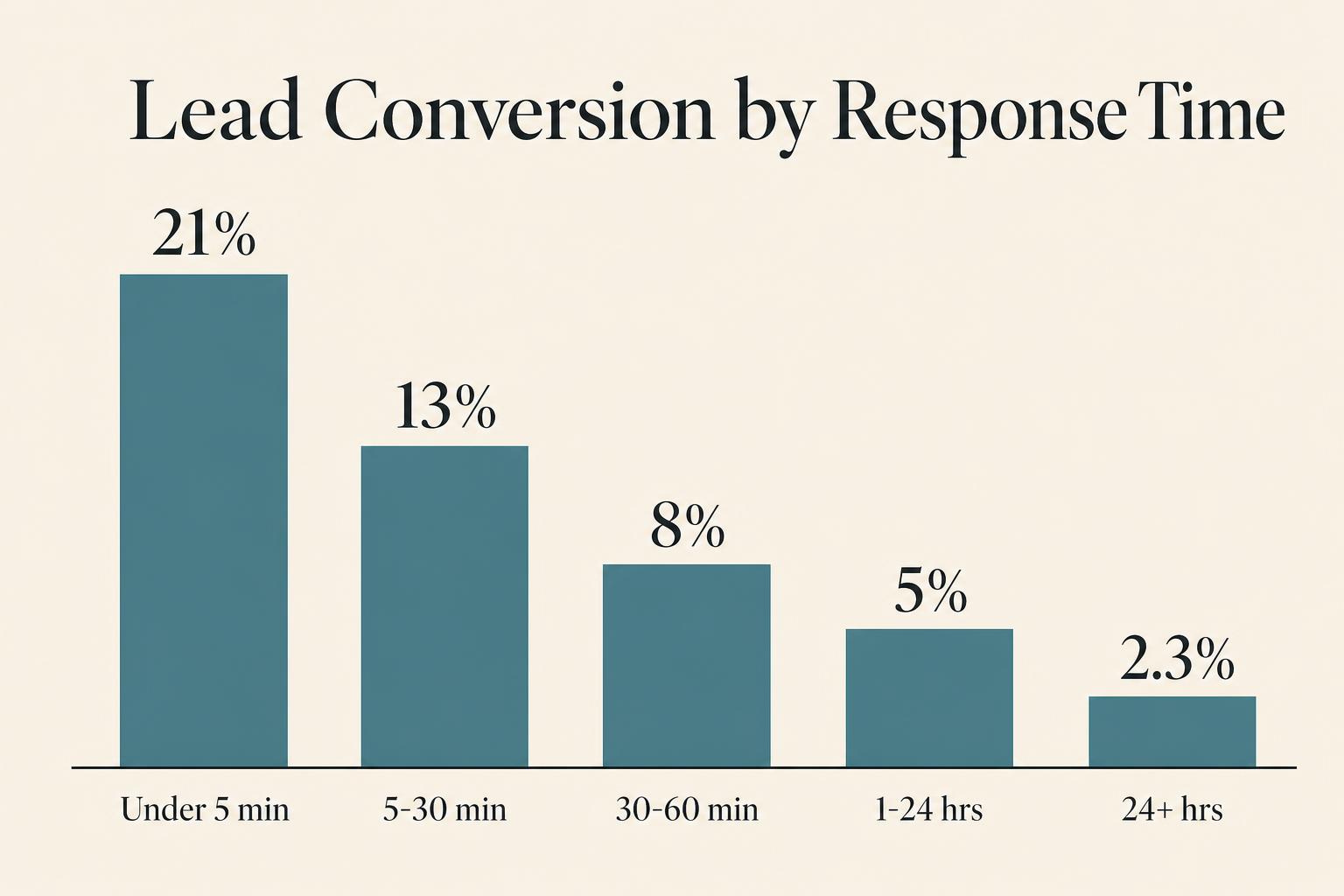
| Response Time | Lead-to-Opportunity Conversion |
|---|---|
| Under 5 minutes | 21% |
| 5-30 minutes | 13% |
| 30-60 minutes | 8% |
| 1-24 hours | 5% |
| 24+ hours | 2.3% |
This is not a marginal difference. A 5-minute response converts at 9x the rate of a 24-hour response. For a typical Australian B2B SaaS company generating 100 inbound leads per month at $30,000 average contract value, the difference between 5-minute and 24-hour response time is approximately $1.8 million in annual pipeline.
The frustrating part: only 7-23% of B2B companies actually hit the 5-minute window. Most are operating at 42-47 hour response times despite knowing the data. The gap isn't knowledge. It's infrastructure.
Why Most Australian B2B Teams Fail at Speed-to-Lead
We've seen the same pattern across dozens of Australian B2B teams. The failure points are remarkably consistent.
1. Inbound leads land in a marketing inbox first.
The most common workflow: prospect fills the form, lead goes to HubSpot or Salesforce, marketing automation sends a templated acknowledgement email, and the actual qualification call happens whenever a sales rep gets around to it. By the time anyone calls, the prospect has filled three other forms.
2. Routing rules are stale or non-existent.
Most teams have routing rules that haven't been updated in 12+ months. Leads get assigned to reps who left, to territories that have been redrawn, or to "round-robin" pools that include people on leave. The lead sits in someone's queue waiting for them to notice it.
3. The "qualification call" is treated as discovery.
When the call finally happens, it's run as a 30-minute discovery instead of a 5-minute qualification. The result: reps put off the call until they have time to prepare for a full discovery, which means hours of delay even when they're technically available.
4. Business hours-only response.
A prospect who fills your form at 6:47pm on a Tuesday gets contacted Wednesday morning at 9:15. That's 14.5 hours of decay. Most form submissions in Australian B2B happen outside the 9-5 window, early morning, late evening, weekends. If your team only responds during business hours, you're losing the majority of your inbound by design.
5. The wrong person makes the first call.
Many teams assign their AEs to make the first qualification call, which is a mistake. AEs are expensive, they're not available immediately, and they don't enjoy qualification work, so it gets delayed. The right person for the 5-minute call is an SDR whose entire job is fast inbound lead qualification.
The Operational Playbook: How to Actually Hit 5-Minute Response
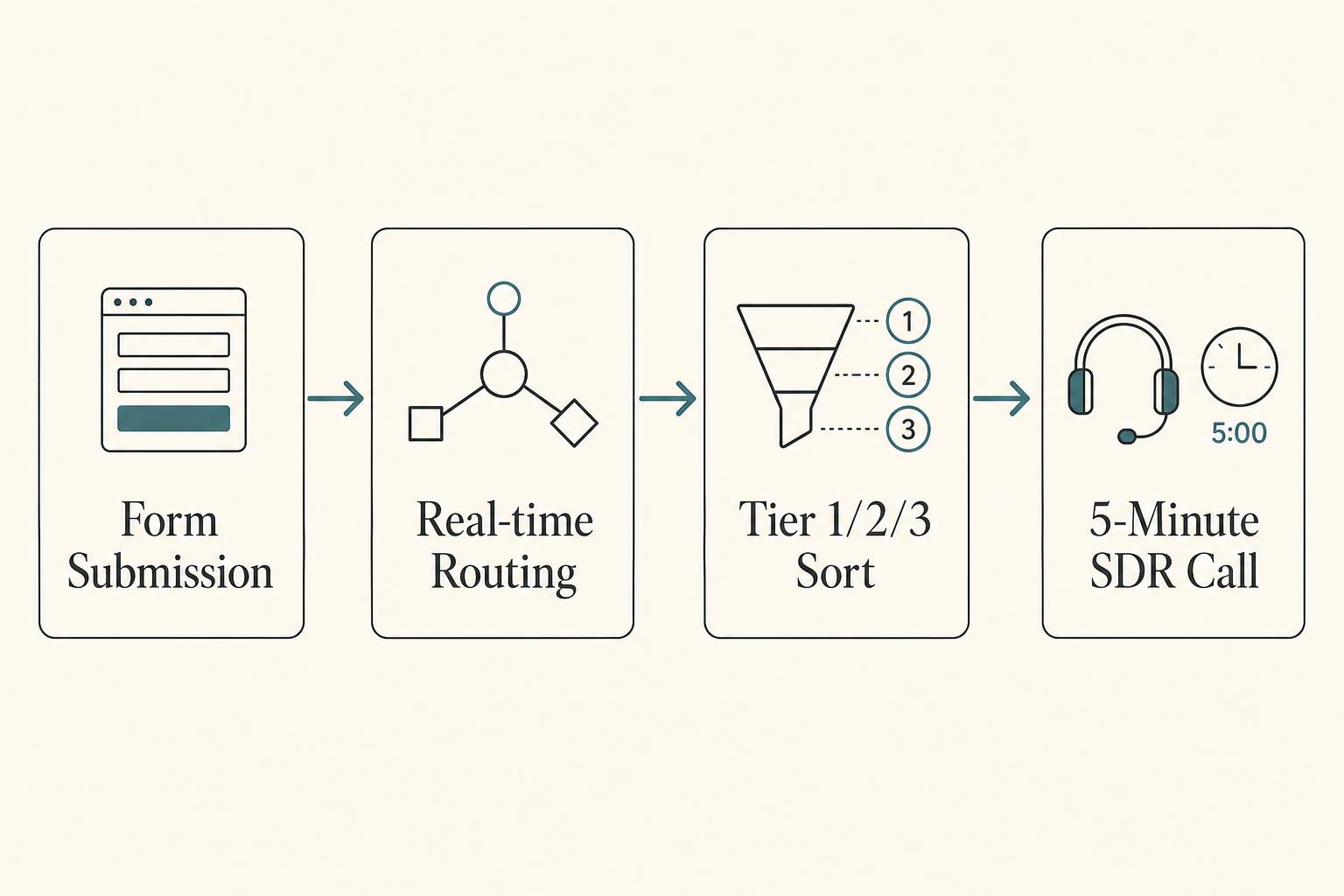
Building genuine 5-minute response capability requires four things working together. Each one alone isn't enough.
1. A real-time inbound notification layer
Every inbound lead needs to surface immediately to a human who can act on it. Email notifications don't work, they get buried. Slack notifications work better but require the recipient to be at their desk. The most effective systems push notifications to a dedicated channel (Slack, Teams) with audible alerts, plus SMS for high-priority leads.
For a lead form to a 5-minute response, the notification has to land within 30-60 seconds of form submission.
2. Tiered routing logic
Not all inbound leads deserve the same response. A "request a demo" submission from a CFO at a $100M company is fundamentally different from a "download our whitepaper" submission from a free email address. Treating them identically is the most common routing failure we see.
Working routing logic looks like this:
- Tier 1 (demo requests, pricing pages, contact sales): Phone call within 5 minutes
- Tier 2 (content downloads from qualified company emails): Email within 5 minutes, phone within 1 hour
- Tier 3 (newsletter signups, generic content): Email within 24 hours, no phone
Most teams treat everything as Tier 2, which means Tier 1 leads get under-served and Tier 3 leads get over-served. Sort the workflow first.
3. Dedicated inbound SDR coverage
Someone has to be on duty for inbound response. The dedicated person doesn't need to be senior, they need to be available, trained on qualification, and able to make a phone outreach call within 5 minutes of a Tier 1 form submission.
For most Australian B2B teams with 30-100 inbound leads per month, this is roughly 0.5 FTE of dedicated capacity. Teams with higher volume need 1+ FTE. The structure matters more than the seniority: it has to be one person's specific job, not "whoever has time."
4. Extended hours coverage
For Australian B2B SaaS in particular, form submissions don't honour business hours. If your form gets submissions between 6pm and 9am, you need coverage for that window. The two practical options:
- Extended SDR hours: Cover 8am to 7pm AEST minimum.
- After-hours auto-response plus morning priority queue: Automated acknowledgment with specific time commitment, then prioritised callback in the morning.
The auto-response option only works if the acknowledgment is genuinely useful (booking link, real ETA, specific contact info) rather than generic "we'll get back to you."
Why Auto-Response Alone Doesn't Work
A common misreading of the speed-to-lead research is "we just need an automated email to fire instantly." This is half right and half wrong.
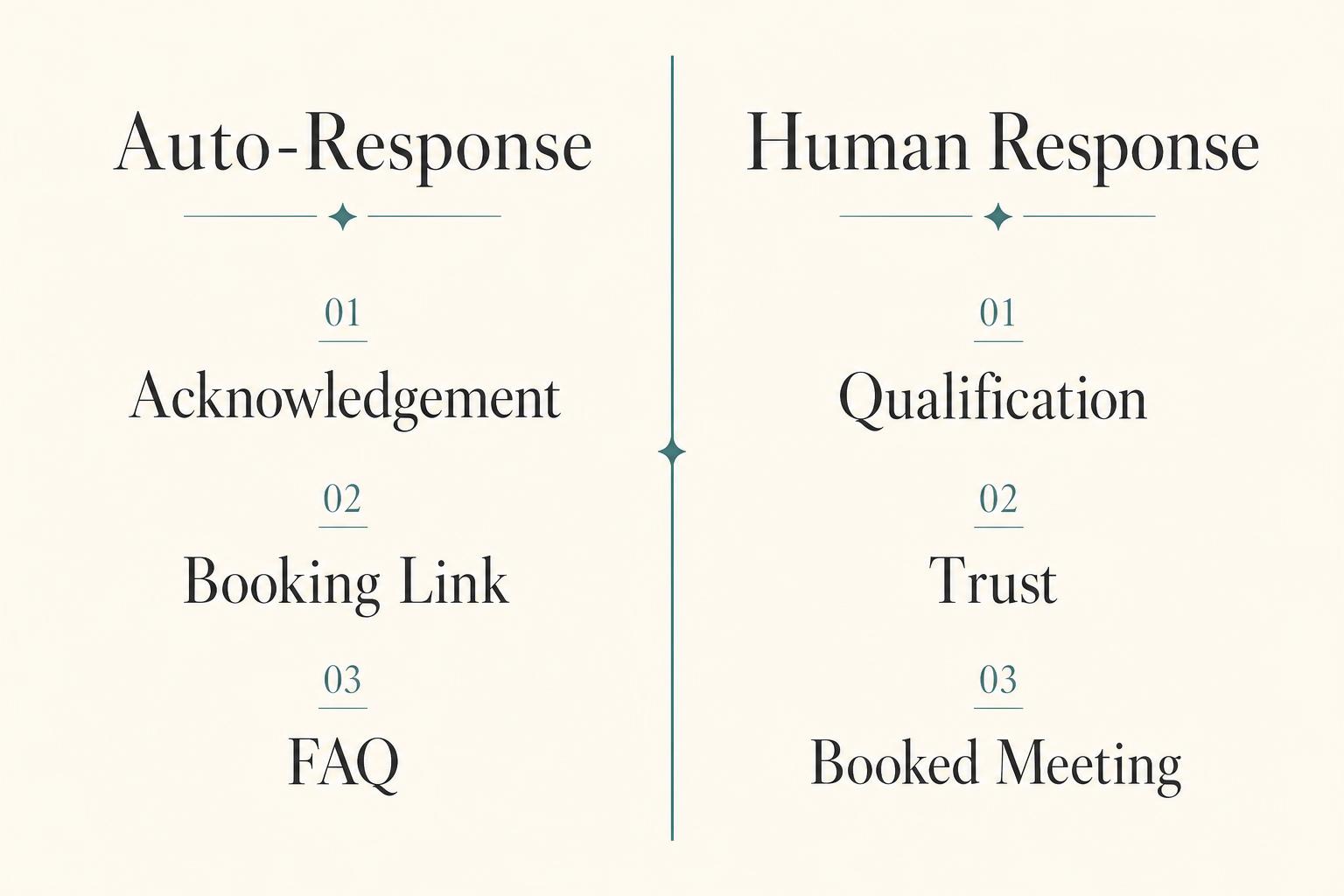
Automated acknowledgement matters. It tells the prospect their submission was received, sets expectations on next steps, and provides immediate value (calendar booking link, relevant content, etc.). Companies that send no acknowledgement at all are bleeding leads to competitors who do.
But automated acknowledgement is not response. The conversion lift from 5-minute response comes from a human contacting the prospect, not from a bot acknowledging their form fill. The MIT data measured first sales activity, calls, meetings booked, or meaningful email replies. Automated emails don't count.
The right architecture is two layers:
- Layer 1 (instant, automated): Confirmation email plus calendar booking link plus content if relevant. Fires within 60 seconds.
- Layer 2 (5 minutes, human): SDR phone call to Tier 1 leads. Personal email to Tier 2 leads. Both come from a real person with a real signature.
Teams that nail Layer 1 but skip Layer 2 see modest conversion improvements (10-20%). Teams that nail both see the 5 to 9x improvements the research describes.
The Human Layer: What an SDR Actually Does on a 5-Minute Call
When someone fills your form and you call them 5 minutes later, the call is fundamentally different from a cold call. The prospect is expecting contact, has their attention on your company, and is in active research mode.
The right script structure for a 5-minute fielding inbound leads call:
"Hi [Name], this is [Caller] from [Company]. I'm calling because you just filled out our form about [specific reason]. I wanted to reach out personally to understand what you're working on and see if there's a quick way I can help. Have you got 90 seconds?"
What this does:
- Acknowledges the form fill: proves the response is genuinely about them, not a random cold call.
- Personal positioning: "I wanted to reach out personally" feels qualitatively different from a sales pitch.
- Short ask: 90 seconds is a low-commitment request, much easier to accept than "got 10 minutes?"
- Genuine help framing: the goal of the call isn't to book a meeting, it's to qualify and route.
What works after that opening:
- Two or three quick qualification questions (company size, role, what they're trying to solve)
- Honest answer to their question if they ask one
- Calendar booking for a longer conversation if they qualify, plus the link sent during the call
- Polite disengagement if they don't qualify
The whole call typically takes 4 to 7 minutes. Done well, it converts 30-40% of Tier 1 inbound to booked meetings, substantially better than any email-only response sequence achieves.
Why Australian B2B Teams Should Outsource This (Not All, But Some)
For most Australian B2B companies with 20-100 inbound leads per month, building real 5-minute response capability in-house is hard. You need someone available 8-10 hours a day, trained on your offering, comfortable making qualification calls, and willing to do it consistently.
Most internal teams can't sustain this. Sales reps don't want to be on inbound duty. Marketing operations can route but can't qualify. Junior people get hired and leave. The 5-minute SLA degrades over time.
This is one of the few outbound functions that frequently works better as an outsourced service than as an internal hire. The reason: a dedicated team running outsourced SDR coverage handles inbound across multiple clients, which means there's always someone available, always someone trained, and the SLA is contractually enforced rather than relying on individual diligence.
This is what Nousu's inbound lead qualification service does specifically. We sit between your form submissions and your sales team, hitting the 5-minute SLA on Tier 1 leads, qualifying inbound, and only booking real opportunities into AE calendars. The economics typically work out to less than half the fully-loaded cost of a dedicated internal SDR.
How to Measure Whether You're Actually Hitting 5 Minutes
Most teams who claim "we respond fast" can't actually prove it. Real measurement requires tracking three metrics:
- Mean response time: the average time from form submission to first human contact attempt. This is your headline metric. Target: under 5 minutes for Tier 1 leads.
- P90 response time: the 90th percentile. This catches the long-tail failures that get hidden in the average. If your mean is 7 minutes but your P90 is 4 hours, you have a workflow gap, not a global problem. Target: under 15 minutes for Tier 1 leads.
- After-hours response time: average response time for leads submitted outside business hours, measured to first contact (which might be next-business-day). This reveals whether your after-hours strategy is real. Target: under 1 hour of the next business day's start.
Most teams measure only the first, which is why they think they're faster than they are. The P90 is usually 5-10x the mean, and it's the P90 that loses deals.
Trends Shaping Inbound Response in 2026
Three patterns are changing how Australian B2B teams handle inbound speed.
AI auto-response is improving but still can't qualify. Tools like Drift, Intercom, and various AI SDR products now respond in under 2 seconds with surprisingly competent initial conversations. They're useful for acknowledgement and basic FAQ handling. They still can't qualify a lead properly, that requires understanding context, ICP fit, and reading buying signals. Teams using AI as a layer (not a replacement) are seeing real efficiency gains.
The 5-minute benchmark is becoming a 60-second benchmark. As more teams hit 5-minute response, the competitive frontier moves. Best-in-class teams are now targeting under 60-second response on demo requests. This is unrealistic for most Australian B2B teams, but it's worth knowing where the standard is heading.
Inbound is converging with outbound. The cleanest workflow we see in 2026 is when phone outreach teams handle both inbound qualification and outbound prospecting. The same SDR who calls cold accounts in the morning handles inbound forms in the afternoon. This produces better conversion rates than separating the functions because the SDR is in calling mode all day. The same logic applies for filling B2B event marketing calendars: continuous calling capability is the underlying capacity that powers all of it.
Common Speed-to-Lead Mistakes to Avoid
- "Round-robin to anyone available." Round-robins distribute load but destroy ownership. Switch to skill-based or tier-based routing instead.
- Auto-booking calendars without qualification. Letting prospects self-book your AE's calendar from a form is fast but skips qualification entirely. The AE wastes hours on unqualified meetings.
- 24-hour SLA dressed up as fast. "We respond within 24 hours" is not fast. It's the average. Don't market this as a strength.
- Treating MQLs and SQLs the same. Marketing-qualified leads (downloaded content, attended webinar) need different response than sales-qualified leads (requested demo, contacted sales). Different SLAs, different channels.
- Skipping the after-hours fix. A 5-minute SLA that only applies 9 to 5 misses 40-60% of submissions. Either extend hours or accept the cap.
Frequently Asked Questions
What is "speed-to-lead" and why does it matter?
Speed-to-lead is the time from a prospect's inbound action (form fill, demo request, content download) to the first meaningful human response from your sales team. It matters because research consistently shows that responding within 5 minutes converts 9 to 21 times better than responding within 24 hours, and the first responder wins roughly 50% of competitive deals. For most B2B teams, it's the single highest-leverage operational metric.
What's the ideal response time for inbound B2B leads in Australia?
Under 5 minutes for Tier 1 leads (demo requests, pricing inquiries, contact sales forms). Under 1 hour for Tier 2 leads (content downloads from qualified company emails). Under 24 hours for Tier 3 leads (newsletter signups, low-intent submissions). These are operational targets, not aspirations, the data supports the 5-minute window as the genuine inflection point.
Why is the 5-minute response window so important?
Three reasons combine. First, attention decay: a prospect who just filled your form is actively thinking about your category for the next 5 to 15 minutes; after that, their attention shifts. Second, competitive timing: most prospects submit forms with multiple vendors; the first responder gets the conversation. Third, intent signal: when someone takes the action of submitting a form, their buying intent is at its peak, every minute of delay reduces that intent.
How do most Australian B2B companies actually perform on speed-to-lead?
Poorly. Benchmark studies place the average B2B response time at 42-47 hours. Only 7-23% of companies consistently hit the 5-minute window. Australian companies aren't materially different from the global average, though sectors with strong sales culture (enterprise SaaS, fintech) tend to perform better than traditional industries (manufacturing, professional services).
Should I respond by phone or email first?
For Tier 1 leads (high-intent forms), phone first, with email as backup if you can't reach them. For Tier 2 leads (content downloads), email first, with phone follow-up within 24 hours. Phone wins on Tier 1 because it captures the prospect's attention while they're still in your funnel; email wins on Tier 2 because the intent isn't high enough to justify interrupting them.
Can AI replace human response for inbound leads?
For acknowledgement and initial qualification, yes, AI can handle the first 60 seconds well. For actual qualification, no, AI still can't read context, ICP fit, or buying signals as effectively as a trained human. The right architecture is AI for instant acknowledgement plus a human follow-up within 5 minutes. Teams using AI as a replacement (rather than acceleration) typically see worse conversion than teams using humans at speed.
What does it cost to build 5-minute response capability?
For an Australian B2B team with 30-100 monthly inbound leads, expect $50,000-$80,000 in annual fully-loaded cost for a dedicated internal SDR. Outsourcing this function via an inbound qualification service typically costs $4,000-$7,000 per month, substantially less than internal hire when you factor in recruitment, training, tools, and management time. See our published pricing for current rates.
How long does it take to fix a slow speed-to-lead problem?
Most Australian B2B teams can move from 42-hour average response to sub 1-hour response within 30 days. Moving from sub 1-hour to sub 5-minutes typically takes 60-90 days because it requires workflow redesign, not just effort. The fastest improvements come from notification infrastructure and tiered routing; the slower improvements come from dedicated SDR coverage and extended hours.
Does speed-to-lead apply to outbound responses too?
Yes, but with different dynamics. For outbound responses (when a cold prospect replies to your email or LinkedIn message), the 5-minute window doesn't apply the same way, the prospect is in lower urgency mode. The right SLA for outbound responses is 30-60 minutes during business hours. Same direction (faster is better), different magnitude.
Should small B2B startups bother with 5-minute response?
Yes, more than larger companies. Early-stage startups have fewer leads and tighter unit economics, so converting each one matters disproportionately. The infrastructure cost is also lower, a founder or first sales hire can personally cover 10-20 monthly inbound leads at sub 5-minute response without dedicated systems. By Series B with 100+ monthly inbound, the systems become essential.
Ready to Fix Your Inbound Response Time?
If you're an Australian B2B team currently sitting at 24+ hour response times, and most teams are, even if they think they're faster, there's real money on the table.
Nousu Collective runs fielding inbound leads as a managed service. We sit between your form submissions and your sales team, hit the 5-minute SLA on Tier 1 leads, qualify everything else, and only book real opportunities into your AE calendars. The economics typically work out to less than half the fully-loaded cost of a dedicated internal SDR.
For broader context on B2B response capability in Australia, see our companion guide on filling executive events and our lead generation services.
If you'd like a free 30-minute assessment of your current inbound response, actual mean and P90 times, where the workflow is failing, what fixing it would cost, book a call below.
Ready to grow your pipeline?
Let's discuss how we can help you book more qualified meetings.
Book a Call with Our Outbound Team