
Your CMO has signed off on the event. The venue is booked, the speakers confirmed, the dietary requirements collected. Two weeks before the date, registrations look healthy. On the day, half the room is empty.
If you've run a B2B event in Australia in the last three years, you've felt this. The gap between registered and showed up is where most event marketing budgets quietly die. The average B2B webinar attendance rate sits at 35-50% of registrants. For premium executive dinners and roundtables, no-shows of 30%+ are common even when the food is good and the topic is sharp.
The fix isn't a better email reminder sequence. It's understanding what events are for, who actually shows up to them, and why phone outbound is the unsexy but essential layer most Australian B2B teams skip.
This guide walks through how Australian B2B companies fill webinars, trade show booths, and executive roundtables in 2026. It draws on benchmarks from Bizzabo, ON24, Univid, and SalesHive, plus operational data from Nousu's 200,000 cold calls , including the calls we make for clients running executive events in Sydney, Melbourne, and Brisbane.
B2B Events by the Numbers: 2026 Benchmarks
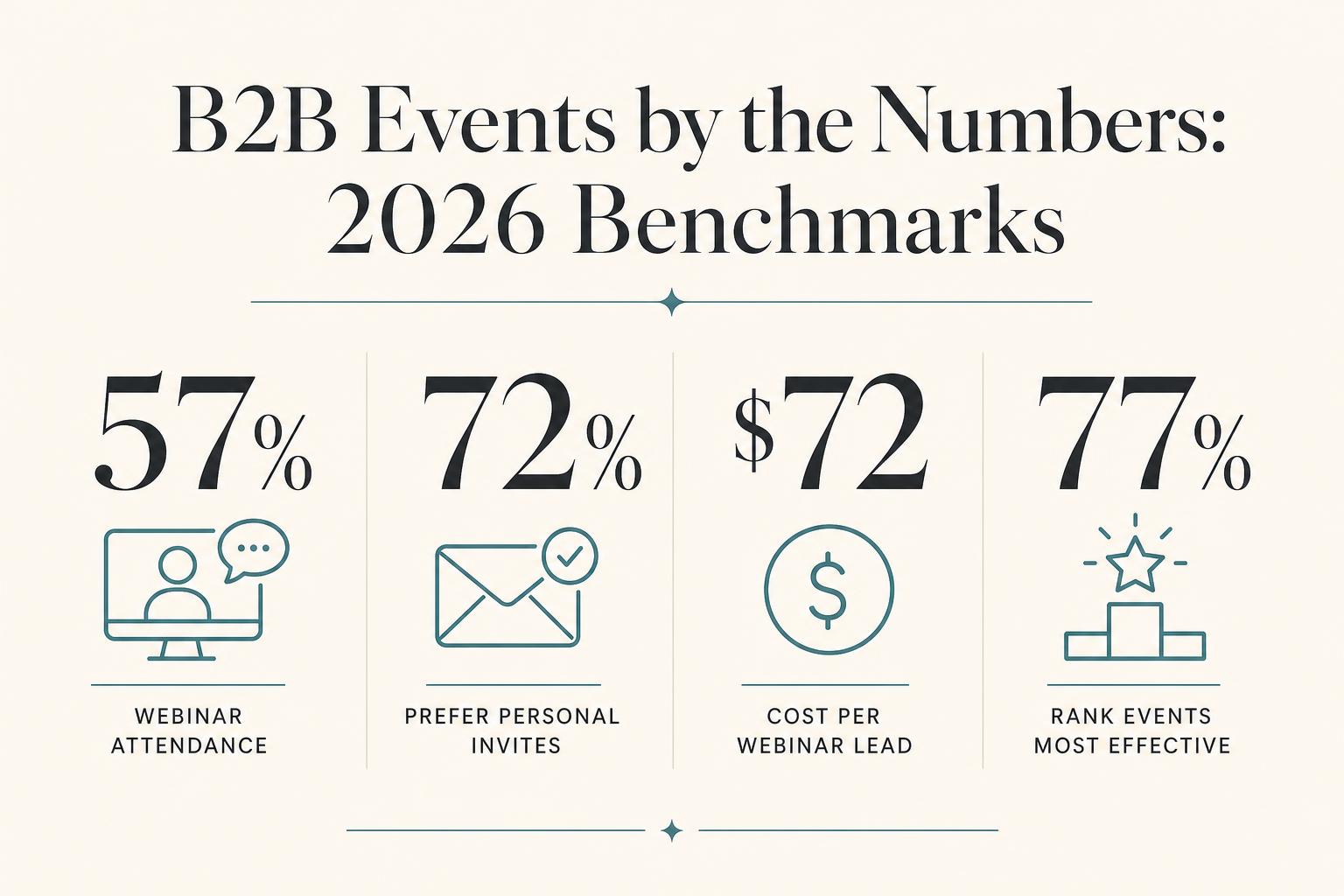
Before we get into strategy, the data:
- 57% average B2B webinar attendance rate (ON24, 2025 dataset)
- 94% of event teams say pre-event email is their most important content (Bizzabo)
- 72% of attendees prefer personalised invitations over generic ones
- 77% of B2B marketers say events are their most effective channel
- $72 average cost per webinar lead, 2.7x cheaper than trade shows
- 60-70% of trade show floor time wasted by teams without pre-booked meetings
The pattern across all these numbers is consistent: events work, but only when the team running them treats attendance as an outbound KPI rather than a passive byproduct of registration.
Why "Just Send Reminder Emails" Fails
The default playbook for filling Australian B2B events looks like this:
- Build a landing page
- Email the database
- Send three reminder emails as the date approaches
- Hope for the best
This works fine for warm audiences. It fails badly for cold outreach to senior decision makers, which is exactly the audience most B2B events want in the room.
The math is straightforward. If you're running an executive roundtable for 12 CFOs in Sydney financial services, your email open rate to cold contacts is going to sit at 20-30%. Your registration rate from those opens will be 1-2%. So to get 12 CFOs to register, you need to email roughly 5,000-6,000 contacts. And of those 12 registrations, statistically 4-5 will no-show.
You've spent six weeks of marketing time to fill a room with 7 executives.
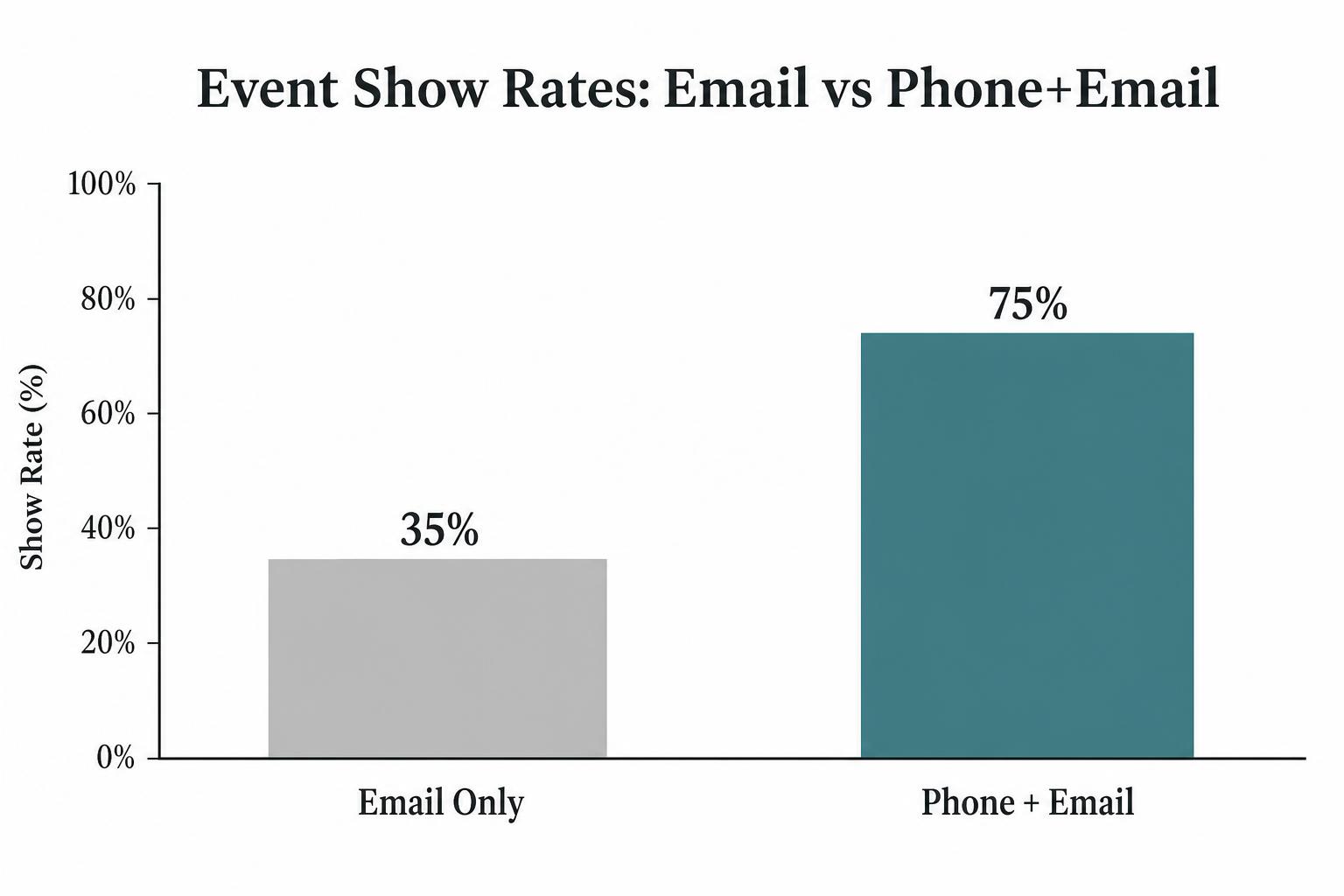
The same campaign with phone outbound layered in produces a different shape entirely. Phone connect rates with Australian senior decision makers run 8-15% in our operational data. Conversion from connect to "yes I'll come" runs 25-35% when the offer is genuinely premium. And, here's the part most people miss, phone-confirmed attendees show up at materially higher rates than email-only registrants. A registrant who has had a real conversation with a human about why they should attend is 2-3x more likely to actually walk through the door.
This is why agencies running serious B2B event marketing campaigns in Australia layer phone outbound on top of email. Email scales the awareness. Phone secures the attendance.
The Three B2B Event Types and How They Actually Fill
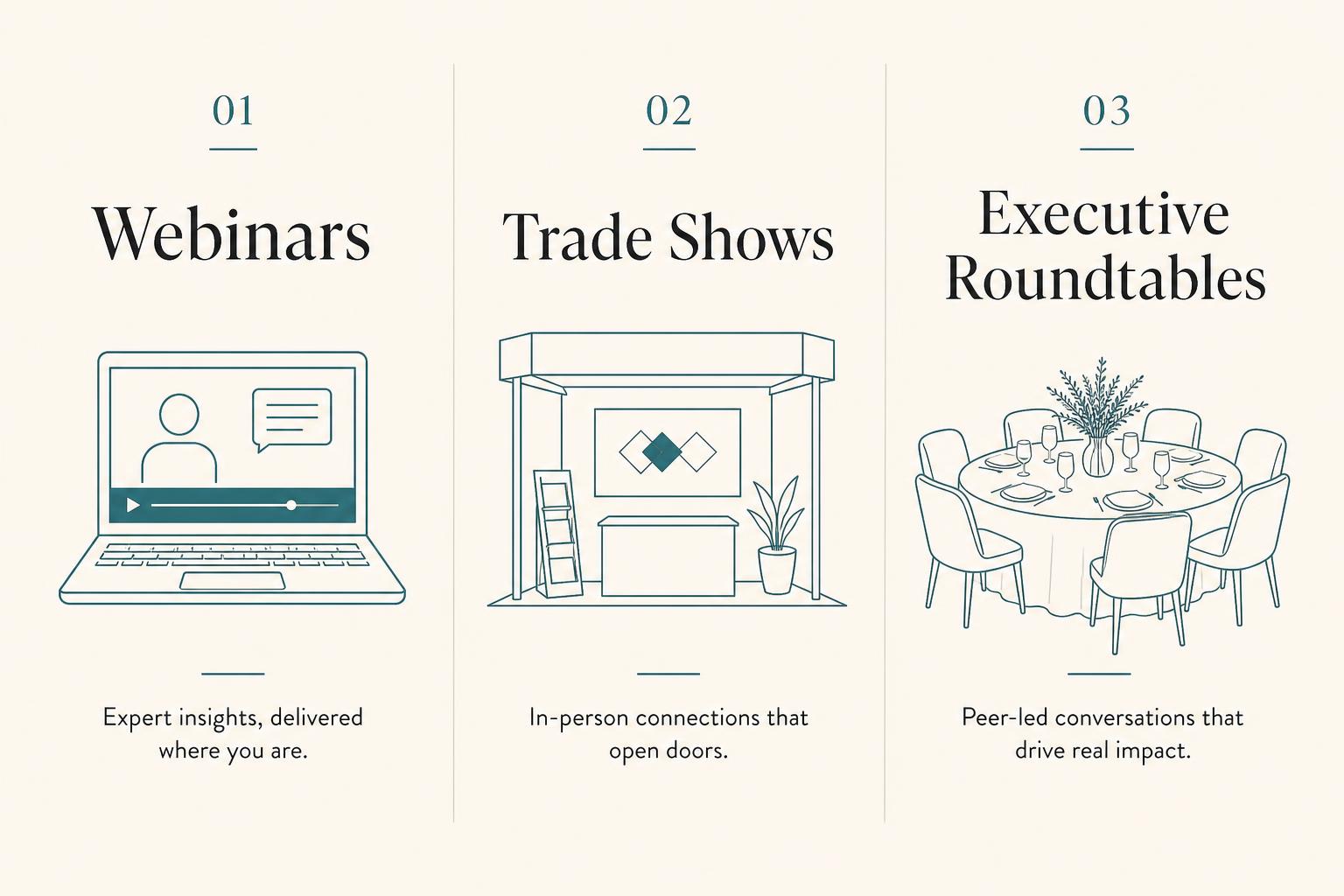
Different event formats need different filling strategies. Treating them the same is the most common mistake we see.
1. Webinars
Webinars cost $500-$5,000 to produce and scale to thousands of registrants. Expected attendance: 35-50% of registrants. Expected meeting conversion from attendees: 5-8%.
How they actually fill: Email-led, with paid social and content marketing as registration drivers. Phone outreach has diminishing returns here because the topic is broad and the commitment level is low. Save phone for the post-attendance follow-up rather than the pre-event invitation.
Where most teams go wrong: Treating webinars as standalone events rather than as warming touchpoints for higher-commitment formats. A prospect who attended your webinar in March is 3x more likely to accept your roundtable invitation in May. Connect the sequence.
2. Trade Shows and Conferences
Trade shows are the highest-cost event channel, a tier-1 industry booth in Sydney or Melbourne runs $40,000-$80,000 once you factor in space, build, travel, and staffing.
How they actually fill (the booth, not the conference itself): Pre-booked meetings with target accounts via event invitation calling in the 4-6 weeks before the event. Teams that arrive without a target account list burn 60-70% of their floor time on unqualified conversations.
The arithmetic: 60 hours of floor time × $1,000+ cost per hour = you can't afford random conversations. Every hour needs to be pre-booked with named accounts.
This is where phone outbound earns its budget. A two-week pre-event calling campaign into your target account list, booking 30-minute meetings at the booth, transforms ROI. We've run these campaigns for Australian SaaS clients and seen meeting volumes go from "5 we vaguely recognised" to "28 named prospects on the booth calendar."
3. Executive Roundtables and Private Dinners
The bottom-funnel event play. 10-20 named accounts in the room. Senior decision makers only. Typically held in private dining rooms in Sydney CBD, Melbourne CBD, or Brisbane.
How they actually fill: Phone outbound to named CXOs at named accounts. Email alone almost never works at this level. Senior decision makers don't take action on cold roundtable emails because: (a) they get dozens of them, (b) the personal touch matters at this level, and (c) the social signal of being personally invited via a phone call from the host is part of the appeal.
This is where Nousu specialises. Our executive roundtables calling campaigns typically target 80-120 named CXOs to fill a 12-15 person room. We connect with 10-15% of those names by phone, secure soft commitment from 30-40% of connections, and confirm 12-15 attendees.
How to Fill an Australian Executive Roundtable: The Operational Playbook
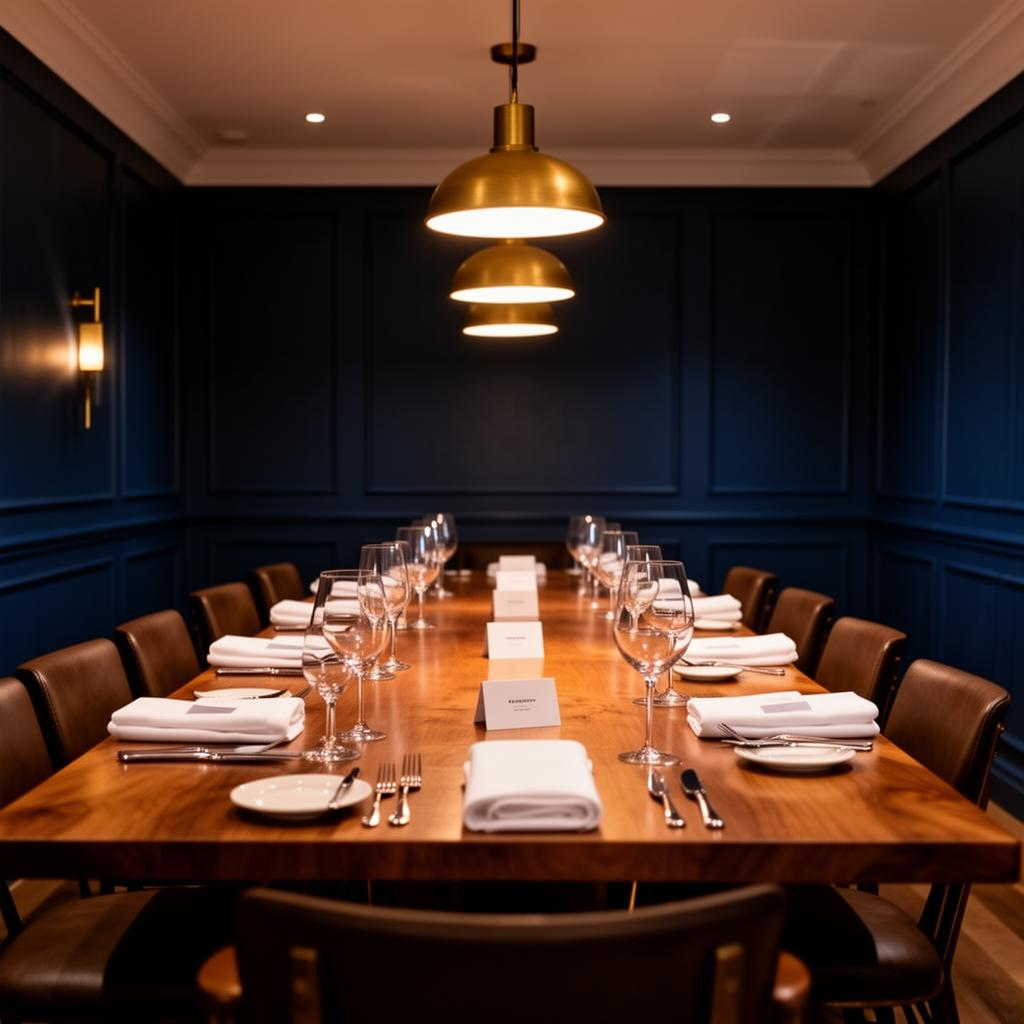
Let's get specific. Here's how Nousu fills a typical 15-person executive roundtable for a SaaS client in Sydney targeting CFOs at $50M+ ANZ companies.
Week -6: Account targeting and list build
Define the ICP precisely. Industry, company revenue band, geographic location, target persona. For a SaaS CFO roundtable, this might be: "CFOs at AU-headquartered SaaS or fintech companies, $20M-$200M ARR, Sydney CBD and surrounds." Build a list of 80-120 named accounts and the specific person at each who matches the persona.
Week -5 and -4: Sequenced outreach kickoff
Email goes out first. Personalised, short, with a clear premium positioning. The email isn't trying to close attendance, it's warming the contact so the phone call lands better.
Phone outbound starts 48 hours after email send. The call references the email but doesn't depend on it. Goal: connect, frame the value, secure a soft yes.
Week -3 and -2: Connect, qualify, confirm
This is the hardest phase. Most calls don't connect on the first attempt. Operationally, this means 4-6 call attempts per contact across different times of day. Connect rates with senior Australian executives run 8-15%, meaning you need 100 named contacts to talk to 8-15 of them.
Of those connections, 25-35% convert to a soft yes when the offer is premium and the topic is sharp. From the 80-120 names, you end up with 25-35 soft commitments.
Week -2 to -1: Hardening the commitments
Soft yes is not attendance. The week before the event, every confirmed attendee gets a calendar invite, a logistics email, and a personal phone call from the host or organising team. This call hardens the commitment.
Without the hardening call, expect 40-50% no-shows on the night. With it, you'll get 20-25% drop-offs, meaning 25-30 soft yeses convert to 15-20 actual attendees.
Week of: Show day
Final reminder calls to all confirmed attendees on the morning of the event. Texting a personal note from the host the afternoon-of lifts show rates by another 5-10%. Small details matter at this stage because the cost of every empty chair is enormous.
Scripts That Actually Get Senior Australians to Say Yes
The single most common mistake we see in event invitation calling is treating the call like a cold sales pitch. It's not. The premise is fundamentally different: you're not asking for a meeting, you're offering access to something exclusive.
Here's the framing we use for executive roundtable calls. Adapt rather than copy:
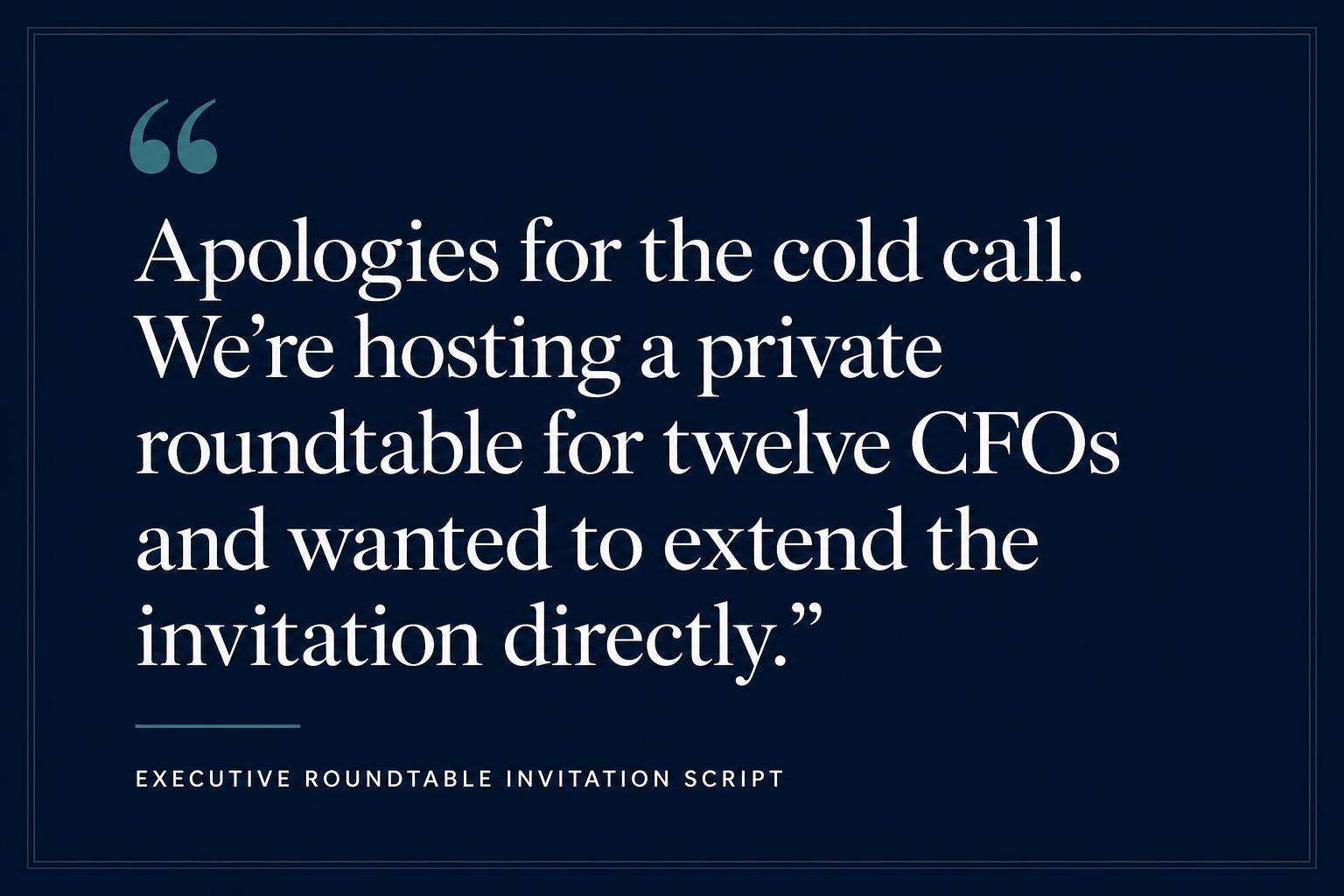
"[Name], this is [Caller] from [Client]. Apologies for the cold call, I'm reaching out because [Client] is hosting a private roundtable for [persona] at [venue, date]. It's a closed table of 12 [persona] discussing [specific topic]. The reason I'm calling you specifically is [genuine reason, recent funding, public statement, peer recommendation, etc.]. The format is dinner plus structured conversation, no sales pitches, attendance is invite-only. Wanted to extend the invitation directly. Is this something that might interest you?"
What works about this:
- No sales pretence. The first 15 seconds make clear this is an invitation, not a discovery call.
- Exclusivity is real. The "closed table of 12" and "invite-only" framing is true, and senior people respond to scarcity.
- Specific personal reason. Generic "we thought you'd be interested" gets dismissed. A real reason, even if it's "we noticed your recent series B", earns the next 30 seconds.
- No close attempt on the call. Trying to "book" attendance on the cold call backfires. The yes you're after is "send me the details."
What doesn't work:
- Leading with "do you have 30 seconds?"
- Calling it a "thought leadership event"
- Saying "industry experts will be presenting"
- Any phrasing that signals this is a webinar in disguise
In-House vs Outsourced Event Invitation Calling
For Australian B2B teams considering whether to do this in-house or use an outsourced SDR support partner, the math is straightforward.
In-house: An internal SDR can do event invitation calling between other duties. The downside is volume, a part-time effort means you'll get through 30-40 calls a day, not the 80-100 daily call volume that fills a roundtable in 6 weeks. Most in-house teams underbudget the calling time required, and the event ends up filled with whoever happened to register from the email blast.
Outsourced agency: A dedicated agency calling team can put 80-100 dials a day onto a named-account list, with consistent follow-up cadences and structured connect tracking. The pricing typically sits at $5,000-$8,000 for a 6-week event filling campaign, which is small relative to the $40K+ cost of running the actual event.
Hybrid: Most sophisticated Australian B2B event marketing programs run a hybrid. Internal team handles target account selection and hosts the relationships. Outsourced team handles the calling volume and the qualification work. This is the model Nousu typically runs for clients filling executive roundtables and trade show booths.
Trends Shaping B2B Event Marketing in 2026
Three patterns are reshaping how Australian B2B companies approach events this year.
Small intimate events are growing faster than large ones. Forrester's B2B event survey shows 58% of marketers planning to increase small, hosted in-person events. The shift is away from large conferences (where you're one of 50 vendors) toward private roundtables and dinners (where you own the room). Filling these smaller events is harder, you can't rely on conference organiser marketing, but the ROI is better.
Hybrid is still winning. Pure-virtual events have lost ground to pure in-person events, but hybrid formats (virtual reach + in-person depth) are growing fastest. The model: run the in-person event for 15 senior people, record it, distribute the content to the broader audience as a "fireside" series.
Phone outreach is being reborn as an event-marketing channel. As cold email saturation has worsened, more Australian B2B teams are layering phone outbound on top of email for event filling specifically. This is a return to traditional outreach, but with modern targeting infrastructure layered on top, named-account calling rather than mass dialling.
How to Choose an Event Invitation Calling Partner
If you're hiring an agency specifically for executive roundtables or event invitation calling, ask these five questions:
- What's your connect rate with Australian senior decision makers? A good agency will give you a specific range (8-15% is realistic). Vague answers signal weak operational data.
- What's your typical name-to-attendee conversion? From 100 named contacts, expect 8-15 connects, 3-6 soft yeses, and 2-4 confirmed attendees. Agencies promising higher rates without context are probably overstating.
- Do your callers work onshore? For Australian executive events specifically, this matters. Offshore callers can fill webinars; they typically can't fill premium roundtables.
- How do you harden soft commitments? The mark of an experienced event filler is having a clear process for converting "send me details" to "I'll be there." Ask them to walk through it.
- Can you handle the volume in our window? Filling a 15-seat roundtable in 6 weeks requires 80-120 calls per week. Confirm the agency has capacity.
For a broader comparison of Australian outbound agencies, see our 15-agency review.
Frequently Asked Questions
What's the average attendance rate for B2B webinars in Australia?
Australian B2B webinars typically see 35-50% of registrants attend live. Industry-specific variation exists, financial services and professional services run higher (45-55%), while broader tech webinars sit lower (30-40%). Adding a third reminder email plus a same-day SMS lifts attendance by ~10 percentage points. Phone confirmation calls lift it by another 10-15 points but are usually only worth it for senior persona webinars.
How much does it cost to run an executive roundtable in Sydney or Melbourne?
Budget $15,000-$30,000 for a 12-15 person private roundtable in Sydney CBD or Melbourne CBD. Breakdown: venue and catering ($8,000-$15,000), speaker fees if external ($2,000-$5,000), invitation calling campaign ($5,000-$8,000), event logistics and follow-up ($1,000-$2,000). Premium venues like Otto, Quay, or Vue de Monde push the catering line significantly higher. See our pricing page for invitation calling specifics.
Why do executive roundtables work better than webinars for senior buyers?
Three reasons: (1) social signal, being invited to an exclusive dinner is genuinely flattering and earns attention, (2) peer proximity, senior buyers want to spend time with other senior buyers, which webinars don't provide, (3) commitment cost, a 3-hour evening commitment screens out the casual attendees, leaving only the genuinely interested.
How many people should I invite to fill a 15-seat roundtable?
For premium Australian roundtables targeting CXO-level personas, plan on 80-120 named contacts to fill 15 seats. The math: 10-15% phone connect rate × 30-40% soft yes conversion × 60-70% soft-to-firm conversion = 2-3 attendees per 100 contacts. This is much harder than filling a webinar, that's the point.
What's the right ratio of email to phone in event invitation campaigns?
For webinars: 90% email, 10% phone (use phone only for senior persona reminders). For trade show booth meetings: 50% email, 50% phone. For executive roundtables: 20% email, 80% phone. The premium and exclusivity of the format determines the channel mix, the higher the commitment ask, the more important phone becomes.
Should I use a senior person to make the invitation calls?
For executive roundtables, yes, the host or a senior team member should make at least the final confirmation calls. For initial outreach, trained SDRs work fine. The key transition: SDRs handle the initial connect and soft yes, senior team members handle the hardening calls in the final week. This split protects senior team time while ensuring senior-to-senior closure.
What's a good show-up rate for B2B events in Australia?
Webinar live attendance: 40-50% of registrants. Trade show pre-booked meetings: 70-80% honour rate. Executive roundtables: 75-85% show-up rate (when filled via phone). The number that should worry you is below 30% on webinars (suggests targeting problems) or below 65% on roundtables (suggests weak hardening process).
How early should I start the invitation calling campaign?
For executive roundtables: 6 weeks out. For trade show booth meetings: 4-6 weeks out. For webinars: 2-3 weeks of email is fine; phone is rarely needed. Starting too late means you can't hit the call volumes needed; starting too early means contacts forget by the date and require re-confirmation.
Does phone invitation calling work for cold (unwarmed) lists?
Yes, but the conversion rate is lower. Calling a fully cold named list will produce a 4-6% attendee-from-name rate. Calling a warmed list (existing CRM contacts or webinar past attendees) will produce 8-12%. For most premium events, a hybrid list, 60% warm, 40% cold to fill specific gaps, performs best.
How do I prove ROI on an executive roundtable?
Track three metrics: (1) named-account pipeline created within 90 days of the event, (2) attendee-to-meeting conversion (target 30-50% of attendees take a follow-up meeting), (3) attendee-to-opportunity conversion (target 10-20% of attendees create a CRM opportunity). For a $25,000 roundtable filling 15 senior buyers, you need roughly 3 opportunities created and 1 to close within 12 months to make the math work at typical Australian B2B ACVs.
What about virtual executive roundtables, do they work?
Less well than in-person, but they have a place. Virtual roundtables have higher show rates (people don't have to travel) but lower meeting conversion (the relationship doesn't deepen as much). Best use case: virtual roundtables as warming events for an in-person roundtable 60 days later. A two-stage program produces better pipeline than either format alone.
What's the right pricing for outsourced event invitation calling in Australia?
Expect $5,000-$10,000 for a 6-week event filling campaign targeting 80-120 named contacts. Agencies charging less are typically running offshore calling teams (acceptable for webinars, suboptimal for premium events). Agencies charging more are usually bundling event logistics and content as well. For pure invitation calling, the $5,000-$8,000 range from an onshore Australian team is the sweet spot. See Nousu's published pricing for context.
Ready to Fill Your Next Event?
If you're running a B2B webinar, trade show booth, or executive roundtable in Australia in the next 90 days, the calling work to fill it should already be underway.
Nousu Collective runs phone-led event invitation campaigns for Australian B2B teams across SaaS, fintech, and professional services. We typically work with marketing leaders 6 weeks before the event, build a named-account list against the persona, run the calling cadence onshore from Sydney, and harden commitments in the final week.
If you'd like a free 30-minute assessment of an upcoming event, what's realistic, what the calling effort would look like, what the budget should be, book a call below.
Ready to grow your pipeline?
Let's discuss how we can help you book more qualified meetings.
Book a Call with Our Outbound Team